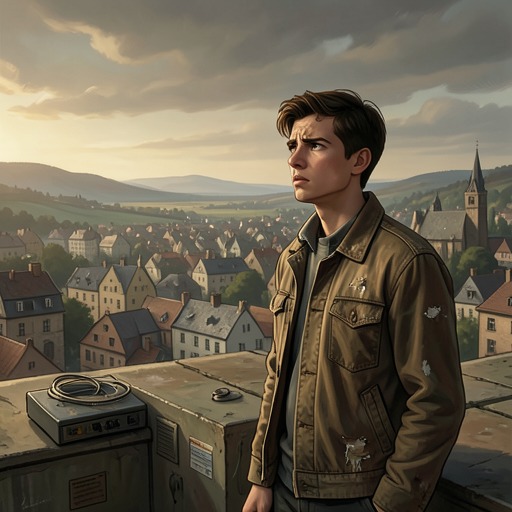
Maude's store
The Devil All the TimeMaude's store is one of Knockemstiff's two general stores and a modest center of daily life in a community where people are closely connected and outsiders remain conspicuous. For Arvin Russell, it is both a familiar landmark on the road through town and, on the evening his father dies, the place where he seeks help beyond his isolated home. Its ordinary roles—as a shop, a workplace, and a point of access to a telephone—give it particular weight when Arvin needs someone to summon the law.
Setting and Place in Knockemstiff
Knockemstiff in 1957 is a small, tightly interrelated settlement of about four hundred people, with two general stores, a Church of Christ in Christian Union, and the Bull Pen. The Russells have rented a house on Mitchell Flats for five years, but their neighbors still regard them as outsiders. Against that social geography, Maude's store is a recognizable stop on the paved road through the middle of town, distinct from the Russells' home above the community and the less settled world around it.
The store also serves as a landmark in Arvin's view of the town. When Willard Russell takes him out in the pickup, their intended trip to Maude's store takes less than five minutes, yet the descent from the Flats feels to the boy like entering another country. The route passes scenes of poverty and disorder, including boys gathered around a gutted deer carcass. Willard turns off before reaching the store, instead driving up the gravel road to the Bull Pen. The store's place in this short journey establishes it as an ordinary destination, even when the family's immediate business takes them elsewhere.
A Familiar Landmark and a Place of Unease
Maude's store is connected to the events around Willard and Arvin before it becomes the site of Arvin's request for help. In the morning, while father and son pray in the woods, Arvin recognizes two hunters from having seen them slouching in an old, rusted sedan in the store's parking lot. Their presence makes the nearby woods feel less secure, although Willard insists that the prayer is their concern. Later, Willard drives to the Bull Pen and finds the same men there with their shotguns. The store thus enters the story first through Arvin's observation: it is a point in the local landscape where the strangers had already been visible.
It also supplies the practical necessities of the family's life. During the weeks when Willard and Arvin continue their prayers amid the animals Willard has gathered, they live on lunch meat and crackers bought at Maude's store. The detail links the store's routine commerce to an increasingly extreme household crisis. The purchases are plain provisions, but they help mark how the family continues to depend on ordinary local services even as Willard's grief and religious desperation transform the woods around their home.
Hank Bell's Life Behind the Store
At the store, Hank Bell's private plans coexist with a repetitive local routine. He has lived for four years in a camper behind the concrete-block building and works for the store. Each week he saves part of the thirty dollars Maude pays him, imagining that he will eventually leave Knockemstiff. He has not decided whether to head north or south, and he tells customers about his intention to go. The store is therefore not merely a backdrop to his life: it is his job and home base, while the money he saves makes it the starting point for a hoped-for departure.
His evenings follow a precise rhythm. At exactly nine o'clock, Hank puts the closed sign in the front window and turns out the lights. He takes a six-pack from the meat case, steps through the back door, and settles in a lawn chair with a cigarette and a small radio. The broadcast carries a Reds game being played on the West Coast, where the time is several hours earlier. Nearby, a cigar tree he planted from a start taken from his mother's former yard has grown nearly five feet. He lost that house to the bank, and the tree remains a small connection to the life he left behind. Around the store, boys gather on the concrete bridge and call out when cars pass; Hank watches the evening mist rise from Black Run Creek. These details place the building within both his ambitions and the unremarkable habits of the town.
Arvin's Request for Help
On the day Charlotte Russell is buried, Arvin crosses Clarence Myers's pasture toward the store carrying a flashlight. Hank has not previously seen him away from the hill alone and knows that his mother has just died. As Arvin approaches, Hank notices that the boy looks pale, sweaty, and unwell, with what appears to be blood on his face and clothes. The store has closed for the night, but Hank offers to reopen if Arvin needs something. Arvin says he has no money; Hank tells him he can owe it. Before the exchange becomes a request for ordinary goods, Arvin asks how to get hold of the law and whether Hank can call for him. He explains that he has never used a telephone.
The request turns the store's familiar service into a decisive act of assistance. Arvin tells Hank that his father is in the woods, then clarifies that he means his father, not his mother, has died. Hank reaches beneath the counter for the phone book but first warns Arvin not to send him on a false alarm. Just days earlier, he had called to report a window peeper for Marlene Williams; it was the fifth such report in two months, and the dispatcher had hung up on him. That history explains Hank's hesitation and shows that a telephone in the store does not guarantee that local complaints will be taken seriously. Still, he accepts Arvin's answer and prepares to help.
Narrative Significance
Maude's store brings together several scales of the story: the limited geography of Knockemstiff, Hank's modest prospects, and Arvin's sudden need to make contact with the law. Its routines are concrete and ordinary—the closed sign, the meat case, the radio, the phone book—while the events that converge there are not. When Arvin arrives, the shop is closed, he has no money, and he has never used a telephone; Hank's willingness to open the store and assist him gives the boy a first step from private discovery toward official intervention.
The location's significance rests on this contrast rather than on any change to the building itself. Earlier, it is a place Arvin passes on a short drive and associates with the hunters' car; later, it is where he can ask an adult for help. Its proprietor's recent experience of being ignored by the dispatcher complicates that appeal without canceling it. In a community defined by close ties but also by neglect, the store becomes an imperfect threshold between the isolated world of the Russell home and the institutions meant to respond to a death.